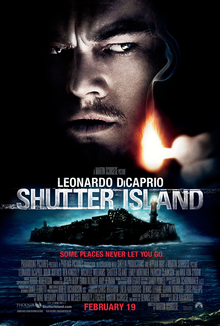
Shutter Island
- Camera techniques in Shutter Island
 A medium
shot of one of the patients is shown where she is holding her index finger to
her lips in an action that could suggests she is telling someone that they
needs to be quiet or not talk. However, it could be that she is mentally
damaged and does random things that could seem odd to others/new comers of the
A medium
shot of one of the patients is shown where she is holding her index finger to
her lips in an action that could suggests she is telling someone that they
needs to be quiet or not talk. However, it could be that she is mentally
damaged and does random things that could seem odd to others/new comers of theasylum.
There are a
few establishing shots of different places in which the characters in the film
are likely to visitor where some events may take place, it also shows that
there are 2 men arriving to the asylum, a pan is also used to show them walking
through the gate to a courtyard where there are some patients being supervised
by staff.
- Mise-en-scene in Shutter Island
An establishing
shot shows it also a somewhat dimmed room with a spot-light on a man sitting at
a desk in the back of the room. There are 3 other men as well in this shot who
are closer to the camera than the man in the back of the room. The dimmed
lighting suggests the connotation of the room being a mysterious place as the
man at the desk is on his own and seems to have his head down, which could mean
that he is at work, but why would he need such a large room to work in? The man
could be hiding something as to why he works in a small section of such a vast
amount of space. A worm’s eye
view shot shows the interior of a patients room, the room itself only a
wardrobe, a bed parallel to the wall and a window above the bed with gridded
wire on the inside of the room, connoting that the patient could be dangerous
and was once able to escape the room; hence the addition of the gridded wires
on the windows.
- Sound techniques in Shutter Island
The
non-diegetic sound if fast-paced at some points as it has been carefully synchronised with the pace of cross-cutting and other editing techniques
between scenes as this is to symbolise the pulse rate of the audience or
yourself in hopes to make your heart beat faster and thus creating the effect
of you being on the edge of your seat when watching. Voice-overs are used to tell you some
of the story line or to forebode/foreshadow what could happen. It is also
another example of non-diegetic sound as it has been edited in over some scenes
in the film.
- Editing techniques in Shutter Island
The
transition of fade to black/white is used to indicate that time is passing by.
This is critical and important to a thriller as events need to be spread out
over a substantial period of time whether it’s a few days or weeks to a couple
months. If all the events in the film happened within a single day or a week
then the audience would become bored.
The addition
of fast-paced editing is used in this film to show danger, or that something is
happening so quickly that it could suggests that something is going to happen
and will constantly keep audience members waiting for quite literally anything
to happen. It also keeps the audience interested and entertained.
Jaws
- Camera
techniques in Jaws
- Mise-en-scene in Jaws
The use of
fake blood in this thriller film is to portray the danger of the shark and his
viscous attacks on the people who enter the water on the beach. As the blood is red, the colour symbolises that the shark is to be feared as the shark species itself is known to be a
hazard and should be kept away from.
At some
points you can see the shark appear in as well as out of the water when it
surfaces, the shark of course is the antagonist which is presented to the
audience through the use of the fake blood and viscous attacks. However, the
shark also subverts to the stereotype of a conventional antagonist. Yet Jaws
also subverts in some ways as he has what could be seen as weapons are his
multiple layers of teeth.
- Sound in Jaws
The
classical orchestral piece of music is used when the shark is near, it
implicates that something bad is going to happen to someone. This piece of
music is used a lot in the film. It foreshadows clearly that a bad event is
going to happen next as it is quite a familiar tune and is played mostly when
an event that is linked around the idea of danger.
This particular tune is slow at the
beginning and gradually becomes faster as the shark approaches whoever or
whatever it is aiming toward going. Once Jaws reaches where it’s trying to get
to the song becomes more and more blood-curdling and keeps to audience in the
midst of the action. Thus presenting the film to be a thriller as it keeps the
audience second guessing what is going to happen next when the music is played.
- Editing in Jaws
Black Swan
 There’s a considerably low low-angle
shot at the end of the trailer when she has transformed into what we call the ‘Black
Swan’, connoting that it’s consumed her. A common convention in thrillers to demonstrate
the point of focus is submissive. There is a number of medium close ups that incorporate
ballerinas feet, which shows them spinning and how ballerinas stand on the tips
of their toes, stressing their commitment to ballet as it appears they’re in
pain. The pace of the transitions between shots gets faster, turning into jump
cuts that
There’s a considerably low low-angle
shot at the end of the trailer when she has transformed into what we call the ‘Black
Swan’, connoting that it’s consumed her. A common convention in thrillers to demonstrate
the point of focus is submissive. There is a number of medium close ups that incorporate
ballerinas feet, which shows them spinning and how ballerinas stand on the tips
of their toes, stressing their commitment to ballet as it appears they’re in
pain. The pace of the transitions between shots gets faster, turning into jump
cuts that
- Mise-en-scene in Black Swan
Mainly black
and white colours are used; this includes the costumes and decoration in the
dance studio. It also illustrates that the place has a more intense and threatening
place. The main setting of the thriller is within a ballet studio which gives
the audience an idea of what the film is about, the mirrors in the studio is a convention
of a thriller as the reflection in the mirrors signify a personal reflection.
We some shots of a woman’s room of which is pink, connoting that this may be
her safe place where she doesn’t have to put her body through so much discipline
to please others.
- Sound in Black Swan
The eerie
non-diegetic music is played in the beginning and is accompanied by a voice
over of a woman talking us through her story of the Black Swan. Once she says “then
it dies” the music abruptly stops, emphasising the ending of her story. The
music starts off somewhat slow and low in volume so the voice over is heard easily
as what the woman is saying is thought of as important. This slowly builds
throughout the trailer. Hooking the audience into the narrative even more.
- Editing in Black Swan

No comments:
Post a Comment